
I Spent 20 Years Selling Websites. So I Built the One That Doesn't Need a Website Guy.
I have been selling and maintaining websites for twenty years. Long enough to have shipped sites in raw HTML, in a dozen frameworks that came and went, and in every version of WordPress since the ones you had to FTP by hand. Long enough to know exactly where the business is buried.
Here is the pattern I watched repeat for two decades. A local business needs a website. They pay someone to build one — usually WordPress, because that is what shops know how to sell. It looks fine on launch day. Then reality sets in. A plugin needs updating. PHP moves a version and something breaks. The contact form stops sending. They want to change their hours, swap a photo, add a new service, post that they are closed for the holiday. None of that is hard. But they cannot do it themselves, because the tool was never built for them. So they call the web company. And they pay. Again next month, and the month after that.
That is the whole model, and I sold it for years: build the site, then rent access to their own website back to them for as long as they own it. It is a good business if you are the web company. It is a quietly terrible deal if you are the diner, the contractor, the fire district, or the church on the corner — organizations that never wanted an IT department and should never have needed one.
The tools act like everyone runs an IT department
WordPress is a genuinely great content-management system if running one is your job. Plugins, updates, security patches, PHP versions, nightly backups, a login that gets brute-forced at three in the morning — that is a real platform, and real platforms need real maintenance. But most organizations do not need a content-management server that needs babysitting. They need five things: a site that is safe, secure, fast, compliant, and easy to change themselves. Everything past that list is overhead someone talked them into.
Miss one update and the site breaks. Miss the wrong one and it gets hacked. That is a second job nobody signed up for, and for twenty years the answer to it has been "so hire us to do the second job." I got tired of that answer. I decided to prove it was obsolete.
So I built Mainfolk
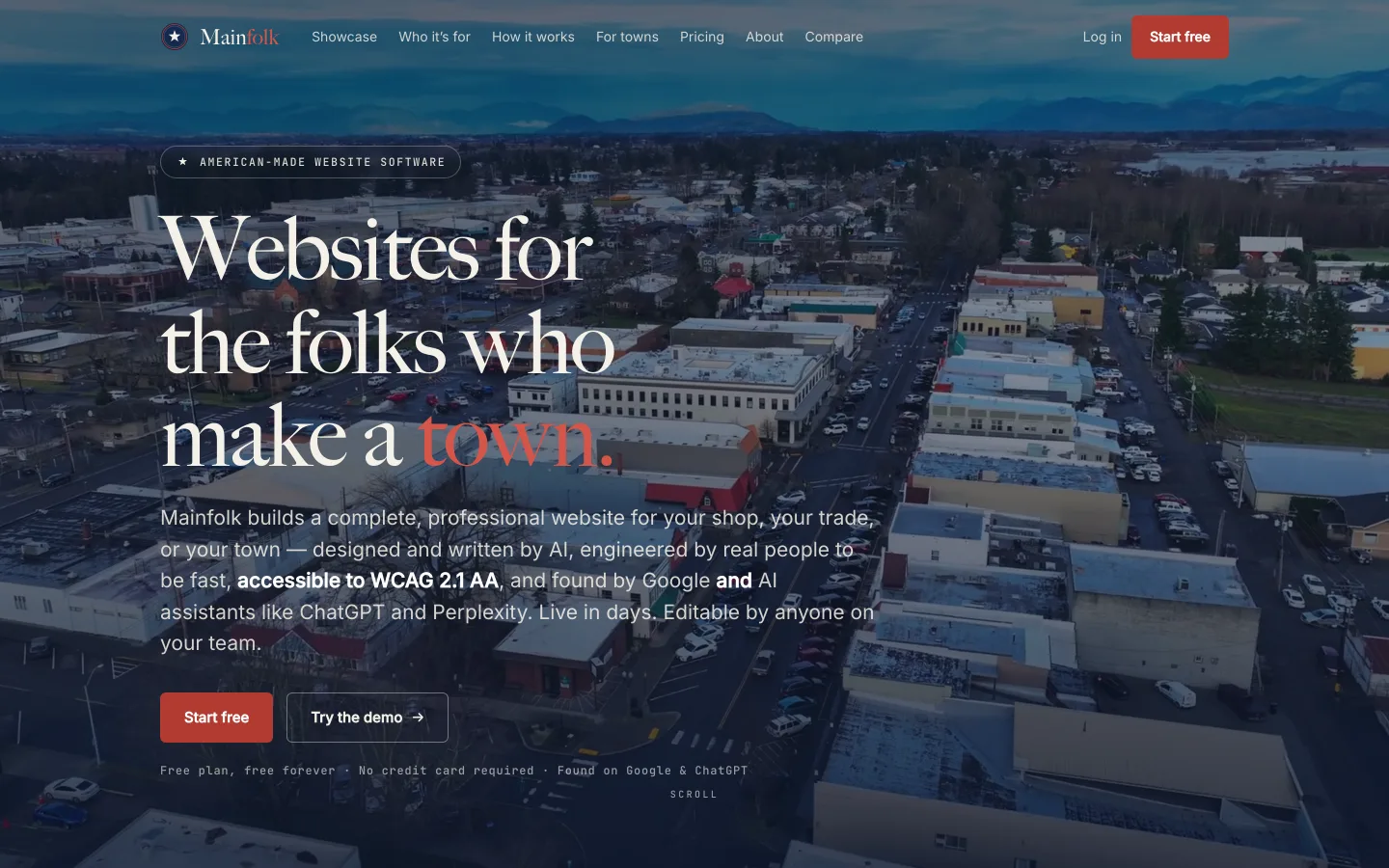
Mainfolk is an AI-native website builder for the folks who make a town — restaurants, trades, shops, nonprofits, and the civic bodies that keep a place running: fire departments, police, cities, districts, and churches. You describe your organization in a sentence or two. The AI writes the copy, designs the layout, picks the palette and fonts, and lays out every page. It hands you a complete, professional, multi-page site — written and designed, not a blank template you have to fill in. You are live in days, not months.
AI-native, not AI-added. The AI is not a gimmick bolted onto an old builder; the whole thing is built around it writing real, structured content from the first draft. But the point I care most about — the reason I built this at all — is what happens after launch:
- You edit it yourself, in plain language, from any device. Click a headline and change the words. Swap a photo from your phone. A firefighter can post an incident from the engine bay. No jargon, no HTML, no support ticket, no invoice.
- There is nothing to maintain, because there is nothing to break. No plugins to exploit, no admin login to brute-force, no server for you to patch. We patch the platform; you never think about it. The site is served as clean, static pages on a global edge network, so it loads instantly everywhere.
- It is found by Google and by AI. SEO is built in by construction, and so is the newer channel most builders ignore entirely — when someone asks ChatGPT or Perplexity "who is the fire department in ___," a Mainfolk site is written to be the answer they read.
- It is compliant on day one. Every site is built to the WCAG 2.1 AA accessibility standard. For government bodies staring down the DOJ ADA Title II deadlines, that is not a nice-to-have — it is the requirement, and most sites quietly fail it.
- It is yours, with no lock-in. Full export of your entire site — pages, content, images, and leads — anytime, free, on any plan. The last thing I wanted to build was another cage.
The part that still surprises people
The free plan is not a crippled trial. It is a genuinely good, complete, live site on a mainfolk.com address, with no ads, including hosting, security, updates, and private visitor analytics. A real website for zero dollars. I can say that plainly because I spent twenty years pricing the alternative.
For businesses that want their own domain and a bit more, plans start at fifteen dollars a month. For civic bodies, Mainfolk Civic is ninety-nine a month — month-to-month, accessibility built in, no RFP — against legacy government-web vendors that run five to twenty-five thousand dollars a year on long contracts. Same category of site. A different decade of software underneath it.
Why I am the one saying this
I am not an outsider throwing rocks at an industry I never worked in. I am the industry — the guy who sold the maintenance contracts, who got the 3 a.m. "the site is down" calls, who has fixed more broken WordPress installs than I can count. That is exactly why I believe the model is over. The technology finally caught up to what these organizations actually needed all along: a site that is safe, secure, fast, compliant, and easy to edit — and that does not need a website guy standing between them and their own front door on the internet.
If you run a shop, a trade, a department, or a congregation, go build one for free and see for yourself. It takes a few minutes and no credit card — and if you ever outgrow it or want to leave, you take everything with you.
Start your free site — no credit card
Mainfolk is a product of Champlin Enterprises, LLC — the software firm I run out of Gurnee, Illinois, building tools that make old, expensive problems disappear.
Links mentioned