
Your Git Repo Is Not a Backup
There’s a moment in almost every project I get called into where someone opens their “repo” and I realize it isn’t one. It’s a folder. A folder that happens to live on GitHub. One branch — main — a wall of commits that all say “updates” or “fix” or, my personal favorite, “asdf”, and somewhere in the history a commit where a database password got pushed to the internet and then “deleted” in the next commit. (It’s still there. It’s always still there.)
This is the vibe-coder model of GitHub: a backup. A magic cloud button that copies your code somewhere safe in case your laptop dies. And to be fair — it does do that. But treating a Git repository as a backup is like treating a hospital as a building with beds in it. Technically true. Wildly missing the point.
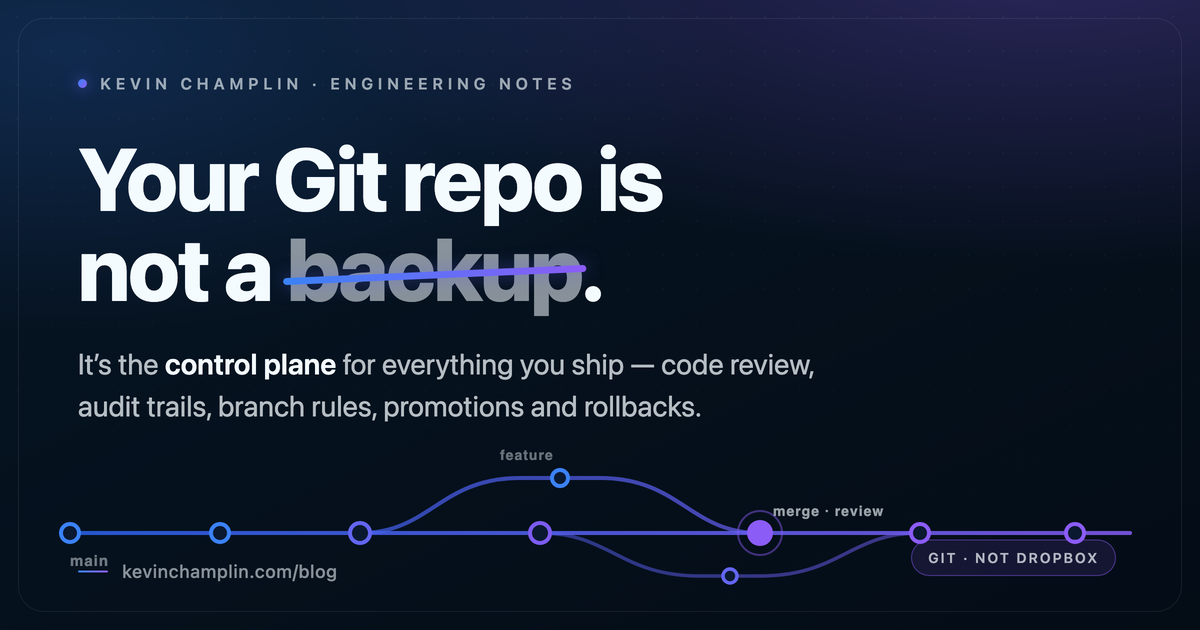
Because to a senior engineer, the repository isn’t where the code is stored. It’s where the code is governed. It’s the control plane for the entire software business — the place where changes get proposed, reviewed, audited, gated, promoted, traced, and (when it all goes sideways) rolled back. The actual source files are almost the least interesting thing in there.
Let me show you the gap. This is the part nobody puts in the “learn to code in 30 days” course, and it’s exactly the part that separates a hobby from a system you can bet a company on.
A backup answers one question. A repo answers a hundred.
A backup answers: “If I lose this, can I get it back?” That’s it. One question, one answer.
A real repository answers questions you didn’t even know you were allowed to ask:
| The “backup” mindset | What the repo actually is |
|---|---|
| A copy of my files in the cloud | A complete, queryable history of every change ever made |
| Somewhere to push when I’m done | The gate code has to pass through before it’s real |
One main branch | A pipeline of environments — dev, staging, production |
| “I’ll just commit it” | A change proposed, reviewed by a human, and approved on the record |
| Trust me, it works | Automated tests, linters and security scans that must go green |
| Who changed this? No idea. | An immutable audit trail: who, what, when, and why |
| It broke, let me dig through everything | Bisect to the exact commit that caused it in seconds |
Every row on the right is something senior teams rely on every single day and most self-taught builders have never been shown exists. That’s not a knock — you can’t use a tool nobody told you was there. So let’s go through them.
1. History is a database you can interrogate
The single most underrated thing about Git is that the history isn’t a list of backups — it’s a structured, queryable record of intent. Every commit is a small, atomic statement: “here is one coherent change, here’s who made it, here’s exactly which lines moved, and here’s a message explaining why.”
When that discipline is there, the history becomes a debugging superpower. The classic example: a bug appears, nobody knows when it started, and the codebase has 6,000 commits. The vibe-coder approach is to stare at the code and pray. The senior approach is git bisect — a binary search through history that finds the exact commit that introduced the bug, usually in a dozen steps no matter how deep the history goes:
$ git bisect start
$ git bisect bad                 # this commit is broken
$ git bisect good v2.3.0         # this release was fine
Bisecting: 412 revisions left to test after this (roughly 9 steps)
# ...git checks out the midpoint, you test, you say good or bad...
$ git bisect good
$ git bisect bad
a3f9c1d is the first bad commit
  Author: somebody who left the company 8 months ago
  Date:   the afternoon nobody remembers
  "refactor pricing rounding"
Nine steps through four hundred commits to the line that broke billing. That’s not backup behavior. That’s forensics. And its companion, git blame, answers the other eternal question — “why on earth is this line here?” — by pointing you at the commit, the author, and the pull request discussion that justified it. The history isn’t storage. It’s institutional memory that outlives the people who wrote it.
2. The pull request is a code audit, not a formality
Here is the idea that reframes everything: in a serious repo, you don’t put code into the project. You propose it.
That proposal is the pull request, and it is where the real engineering happens. Code doesn’t land on main because you wrote it. It lands because another engineer read it, questioned it, and approved it — on the record, with their name attached. A pull request is a structured audit: here’s exactly what I want to change, here’s the diff line-by-line, here’s why, now tear it apart.
This is also where CODEOWNERS earns its keep — a file that says “nobody touches the payments module without sign-off from the payments team” or “the auth code requires a security reviewer.” GitHub enforces it automatically: open a PR that touches a protected path and the right reviewers are required before it can merge. Expertise gets routed to exactly the change that needs it, without anyone having to remember to ask.
The scary part of AI-assisted coding isn’t that the AI writes code. It’s that it writes plausible code — code that looks right and runs — and a vibe coder merges it unread. The pull request is the exact checkpoint where a human is supposed to look. Skip it and you’re not shipping software; you’re shipping a guess at scale.
3. Branch protection is the rulebook that makes “main” sacred
On a vibe-coder repo, anyone can push anything to main at any time, including a force-push that silently rewrites history and erases other people’s work. On a professional repo, main is locked down by branch protection rules — a policy layer GitHub enforces server-side. You don’t get to forget the rules, because the rules aren’t in your head; they’re in the repo.
| Rule | What it stops |
|---|---|
| Require a pull request before merging | Nobody pushes straight to main — ever. Everything is reviewed. |
| Require N approvals | Code lands only after one (or two) other humans sign off. |
| Require status checks to pass | You cannot merge if tests, linting or security scans are red. |
| Require branches to be up to date | No merging stale code that was never tested against current main. |
| Require signed commits | Every commit is cryptographically proven to come from who it claims. |
| Block force-pushes & deletions | History is append-only. Nobody can quietly rewrite the past. |
| Require linear history | A clean, auditable timeline instead of a tangle nobody can read. |
Look at what that table really is: it’s organizational policy compiled into something a machine enforces. “We review our code” stops being a hope and becomes a wall. That’s the leap from a folder to a control plane — the rules don’t depend on everyone being disciplined on a Friday afternoon.
4. “main” isn’t your code. It’s an environment.
To a vibe coder, main is the project. To a senior engineer, main is one stage in a promotion pipeline. Code is promoted through environments the way a candidate is promoted through interviews — it has to earn each step:
feature/new-pricing  ->  develop  ->  staging  ->  main (production)
   you build here       integrated   QA tests     real customers
                        with others   like prod    real money
Each arrow is a gate, not a copy-paste. A release gets tagged (v2.4.0) so there’s a named, immutable point you can deploy and re-deploy on demand. And here’s the payoff almost nobody appreciates until the night they need it: because every deploy points at a specific commit, rolling back a broken release is just deploying the previous good SHA. Production is on fire at 11pm? You don’t debug under pressure. You roll back to the last known-good commit in thirty seconds, sleep, and fix it properly in the morning. A backup can’t do that. A control plane does it routinely.
5. The repo is a trigger surface: CI/CD
The instant code arrives in a real repository, it sets off machinery. This is continuous integration — and it turns the repo from passive storage into an active enforcement engine. Push a branch, open a PR, and within seconds the repo is running, automatically:
- The full test suite — does this change break anything that used to work?
- Linters and formatters — does it meet the team’s code standards?
- Type checks and a build — does it even compile and bundle?
- Security and dependency scans — did it introduce a known vulnerability?
And remember rule #3 in that branch-protection table: require status checks to pass. Those two features click together into one hard guarantee — you physically cannot merge red code. The repo refuses. It doesn’t matter how senior you are or how sure you are; if the tests fail, the merge button is disabled. That’s not bureaucracy. That’s the codebase defending itself from all of us on our worst days.
6. Supply-chain & secrets: the part that should genuinely scare you
Modern software is 90% other people’s code — the dependencies you pulled in. A real repo treats that as a live security surface, not an afterthought. GitHub bakes in defenses the vibe-coder repo has switched off (or never knew existed):
- Dependabot watches every dependency and opens a pull request the moment one of them ships a security fix — the repo literally proposes its own patches.
- Secret scanning watches what you push and screams when an API key, token or database password lands in a commit — the single most common, most expensive vibe-coder mistake there is.
- Signed commits and provenance prove a given line of code actually came from who it claims, which is the whole ballgame once supply-chain attacks enter the picture.
- An SBOM (software bill of materials) is a generated inventory of every component you ship — so when the next big vulnerability drops, you can answer “are we affected?” in minutes instead of days.
Here’s the uncomfortable truth: that password I mentioned in the first paragraph — committed, then “deleted” — lives in the history forever because history is append-only (see rule #3, the one that protects you). Deleting it in a later commit doesn’t remove it; it just hides it from the latest view. Anyone with the repo can check out the old commit and read it. A repo that understands this scans for the key on the way in and blocks it. A “backup” cheerfully stores your leaked credentials in perpetuity and hands them to the next person who clones it.
7. The audit trail is the business
Strip away the engineering for a second and look at what a governed repo produces as a byproduct: a complete, tamper-evident record of every change to the product, who authored it, who reviewed it, who approved it, what tests it passed, and when it shipped. Each line traces back to a person and a reason.
That record is not a nice-to-have. It’s the thing an auditor asks for in a SOC 2 review. It’s what HIPAA and regulated industries require — demonstrable change control. It’s how you answer “who approved the change that touched patient data on March 3rd?” with a link instead of a shrug. The same mechanics that make engineers’ lives easier are, from the business side, the difference between a company you can sell, insure, and pass an audit on — and a folder of code you’re hoping nobody looks at too hard.
The vibe-coder failure modes, in one place
None of this is theoretical. These are the exact patterns I walk into, and every one of them is a control the repo would have given you for free:
- Committing the
.envfile — secrets in history forever. Secret scanning + a.gitignorestop it cold. - One branch, direct to
main— no review, no safety net. Branch protection makes it impossible. - Force-pushing
main— quietly erasing a teammate’s work. Blocked by a single setting. - The 4,000-line “updates” commit — impossible to review, impossible to bisect, impossible to revert cleanly. Small, atomic, well-titled commits are the whole point.
- Merging AI-generated code unread — the pull request exists precisely so a human looks before it’s real.
- “It works on my machine” — CI runs it on a clean machine every time so “my machine” stops being a variable.
So what is a repo, really?
A Git repository is the operating system for how your software changes. Backup is one feature of it — roughly the least important one. The real product is governance: a complete history you can interrogate, a review process that catches mistakes before customers do, rules a machine enforces so humans don’t have to be perfect, environments you promote through, pipelines that refuse to ship broken code, and an audit trail you can stake a company on.
That’s why “just push it to GitHub” and “we run a disciplined repo” are not the same sentence, and the distance between them is most of what senior engineering actually is. The good news: none of it requires genius. It requires knowing the controls exist and turning them on — in the right order, for the way your team actually works.
That’s the part I do. If your repo is really a folder — or if you’re shipping AI-assisted code faster than anyone’s reviewing it — that’s a fixable problem, and fixing it is usually a quieter, cheaper afternoon than you’d expect.
Get your repo audited GitHub: About protected branchesLinks mentioned