
Marketing's Great Divide: Legacy Overhead vs. AI Agility
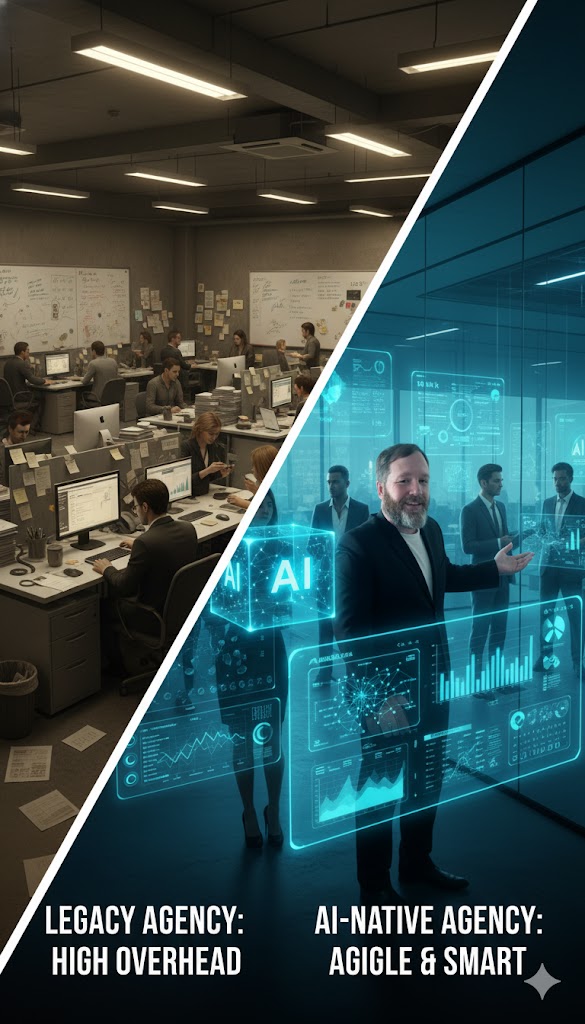
Today, a new breed of agency is emerging. These aren't just agencies using AI; they are agencies built around AI, truly adopting it at their core. And the difference isn't just incremental; it's existential.
The Weight of Legacy
Traditional agencies operate with significant fixed costs: large teams, expensive leases, and the sheer inertia of established processes. Each campaign often requires assembling a new cohort of strategists, copywriters, designers, and media buyers, each adding to the project's burn rate. While expertise is invaluable, the delivery mechanism itself is often inefficient. Iterations are slow, A/B tests are manual, and the ability to scale up or down quickly is constrained by headcount.
This isn't to say traditional agencies lack talent. Far from it. But their operational structure can often stifle the very innovation their clients crave, making them less competitive against the agile, AI-native players.
The Rise of AI-Native Agility
Now, imagine an agency where:
Content generation isn't a week-long brainstorming session followed by endless revisions, but an AI-assisted sprint, producing multiple variations in hours, perfectly tailored to specific audience segments.
Market research and trend analysis aren't reliant on expensive, time-consuming reports, but on AI algorithms sifting through vast datasets in real-time, identifying niches and opportunities before competitors even know they exist.
Media buying and optimization isn't a human guessing game, but an intelligent system constantly adjusting bids, placements, and creatives to maximize ROI across hundreds of platforms simultaneously.
Personalization at scale becomes a reality, delivering unique messages to millions of individuals, driven by predictive analytics rather than broad demographic assumptions.
This is the power of a truly AI-adopted agency. They're not just tacking AI onto old workflows; they're rebuilding their entire operational DNA around it.
More Than Just Tools: A Mindset Shift
As someone with a background in full-stack engineering, I've seen countless technologies emerge. What separates a true disruptor from a fleeting trend isn't just the tech itself, but the mindset of those wielding it. Treating AI as another tool in the belt is one thing; architecting your entire approach to leverage its strengths is another.
AI-native agencies embrace:
Efficiency: Automating repetitive, data-heavy tasks frees human talent to focus on high-level strategy, creativity, and client relationships.
Scalability: The ability to handle vast amounts of data and execute complex campaigns without proportional increases in headcount.
Precision: Data-driven decisions replace gut feelings, leading to more effective and measurable outcomes.
Innovation: Constantly exploring new AI capabilities to offer novel solutions that legacy models simply cannot.
It’s not about replacing humans with AI; it's about augmenting human ingenuity with unparalleled computational power. The "2 a.m. debug" mindset I learned in engineering applies here too: understand the system, build with guardrails, ensure observability, and focus on real, testable outcomes. AI, when properly engineered into an agency's core, delivers horsepower, not just hype.
The Future is Lean and Smart
The choice for marketing agencies is becoming increasingly clear: adapt or be outmaneuvered. Those who truly integrate AI—not as a gimmick, but as fundamental operational intelligence—will be the ones delivering groundbreaking results, attracting top talent, and providing undeniable value. The future of marketing isn't just digital; it's intelligent, agile, and wonderfully unburdened by legacy overhead.